

Blog
Freemasonry Versus Secret Societies Explained

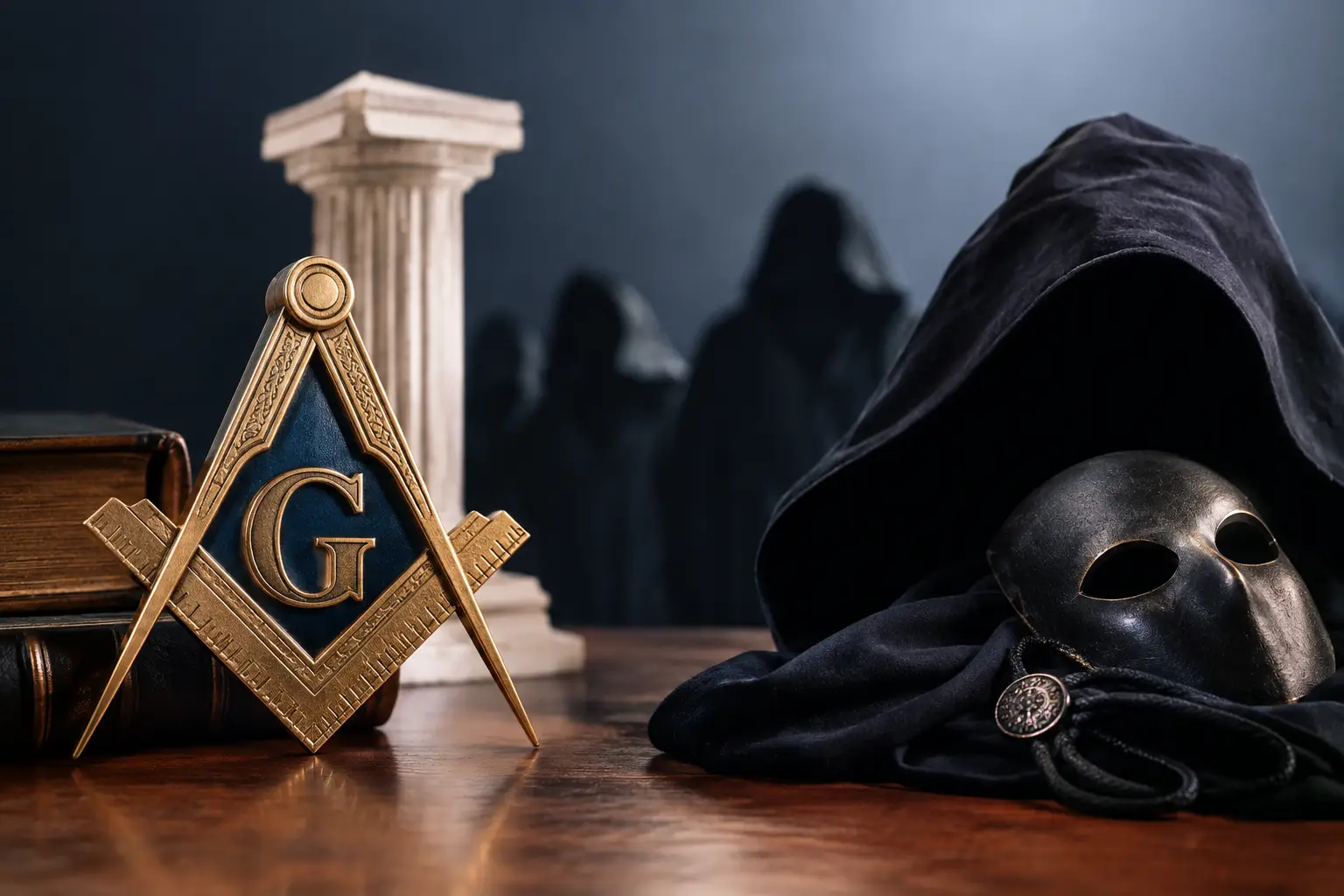
A closed door, a ceremonial apron, and unfamiliar symbols can make Freemasonry versus secret societies seem like a simple comparison. Yet the question rests on an assumption worth examining: that any organization with private ceremonies must be secret in its purpose. Freemasonry has traditions that are reserved for members, but its aims, values, charitable work, meeting places, and pathway to membership are openly described.
Freemasonry is one of the oldest secular social and charitable organizations in the world. It brings men together across backgrounds to build friendships, reflect on character, support their communities, and practice the values of Integrity, Friendship, Respect, and Service. Understanding the difference between privacy and secrecy helps replace speculation with a clearer picture.
What people usually mean by a secret society
The phrase “secret society” is often used broadly. It may describe a group with concealed membership, hidden objectives, restricted information, or influence exercised outside public scrutiny. Sometimes it is used as a dramatic label for any club with ceremonies, symbols, or an invitation process.
That broad use creates confusion. Private associations are not all alike. A family may keep personal matters private; a business may protect confidential information; a faith community may reserve certain observances for adherents. Privacy alone does not reveal an organization’s purpose or character.
A more useful question is not whether a group has anything private, but what it makes public and what it asks of its members. Are its principles stated plainly? Can people understand how to join? Does it have a visible presence in its community? Is it accountable to established rules and leadership? Does it encourage members to act honorably in public life?
These are practical standards for considering Freemasonry versus secret societies, and they point to meaningful differences.
Freemasonry is private in ceremony, public in purpose
Freemasonry does have private elements. Its ceremonies are intended to be experienced by candidates in their proper setting, alongside fellow members. Certain signs, words, and modes of recognition have traditionally been kept within the fraternity. These customs are part of a shared ceremonial language, not a hidden program for social or political control.
The reasons for that privacy are largely ceremonial and personal. A degree is designed as an experience that invites reflection on moral lessons, responsibility, and the duties people owe to one another. Knowing every detail in advance can lessen the impact for a new member, much as knowing the final scene of a play changes the first viewing.
What Freemasonry does not conceal is its general purpose. Masonic organizations publish information about their history, values, charitable activities, membership qualifications, and governance. Lodges meet in identifiable places, take part in civic and charitable life, and welcome questions from prospective members and the public. Freemasons’ Hall, for example, is both a working home for Freemasonry and a place where visitors can encounter its history.
This distinction matters. A private tradition can still be accountable and accessible. Secrecy, by contrast, is often about preventing outsiders from understanding an organization’s goals, authority, or actions.
Clear values, not hidden agendas
Freemasonry asks its members to strive for high standards in everyday life. It does not promise wealth, professional advancement, or special influence. It is not a network for favors, and membership should never be used to gain unfair advantage.
Regular Freemasonry is also nonpolitical and nonsectarian. Lodges are not places for partisan political debate or religious argument. Members may hold different political views and belong to different faiths, but the Lodge offers a setting where mutual respect comes before disagreement. In regular Masonic traditions, candidates are expected to affirm a belief in a Supreme Being, while Freemasonry does not prescribe a particular religion or replace anyone’s faith.
That approach can feel unusual in a culture where many institutions are defined by political alignment or professional status. Freemasonry instead asks members to meet one another first as equals. The goal is not uniformity of opinion. It is the practice of civility, self-discipline, and goodwill.
How Lodges are organized and accountable
Another difference between Freemasonry and groups commonly described as secret societies is the visibility of Masonic organization. A Lodge is a local body of Freemasons, led by officers who serve defined roles and are chosen according to established procedures. Lodges operate under the authority of a Grand Lodge, which provides constitutions, rules, and standards.
This structure is not mysterious. It gives members a framework for meetings, ceremonies, finances, charitable giving, and conduct. It also makes clear that no individual Mason speaks for all Freemasonry merely by claiming membership. Practices can differ by jurisdiction, but regular Lodges are part of a recognizable system with written rules and accountable leadership.
Membership is likewise more straightforward than many people assume. A man who is interested in joining is encouraged to learn about the organization, speak openly with local members, and make his own inquiry. He should be joining because he wants to contribute, grow, and form lasting friendships – not because someone has pressured him or offered him an advantage.
Symbols are teaching tools, not coded control
Masonic symbols are among the most visible sources of misunderstanding. The square and compasses, working tools, and images drawn from the building of King Solomon’s Temple appear in Lodge rooms, books, architecture, and public displays. For some observers, symbols suggest a hidden message. For Freemasons, they are teaching tools.
The square reminds a Mason to act fairly. The compasses encourage self-control and proper boundaries. The level speaks to equality, while the plumb encourages upright conduct. Their meaning is moral rather than magical. They give members memorable ways to consider how they live, lead, work, and serve.
Symbols do not remove a member’s responsibility to think for himself. They invite reflection. Like a national flag, a wedding ring, or a university seal, their power comes from shared meaning and the conduct expected of those who use them.
Charity offers a visible test
If an organization claims to serve the public, its actions should be possible to see. Freemasonry has a long record of charitable support, from local giving and volunteer efforts to major contributions in health, education, disaster relief, and community care. Individual Lodges often respond to needs close to home, where members can see the result of their efforts.
Charity is not an afterthought or public relations exercise. Service is one of Freemasonry’s central commitments. It gives members a practical way to turn fellowship into action and to use time, skills, and resources for the benefit of others.
Of course, charitable giving alone does not prove that any organization is worthy of trust. The stronger point is that Freemasonry’s service is consistent with its stated values and is carried out in the open. The public can judge the work by its results.
Why misconceptions persist
Misconceptions have endured partly because Freemasonry is old. Its language, regalia, and formal ceremonies can feel unfamiliar to people who have not encountered them. Popular fiction has also treated Masonic symbols as convenient material for conspiracies, often blending history with invention.
There is a trade-off in maintaining tradition. Preserving meaningful ceremonies can create a sense of continuity and belonging, but it can also leave room for outsiders to imagine more than is there. The answer is not to abandon every private custom. It is to explain the organization’s values and public role clearly, while welcoming sincere questions.
For someone considering membership, the best test is personal and practical. Meet Freemasons. Ask what their Lodge does for its members and community. Learn what is expected of a candidate. Consider whether the values of integrity, friendship, respect, and service match the life you want to build.
Freemasonry does not ask people to suspend their judgment. It asks them to bring their best judgment, their willingness to learn, and their desire to be useful to others.