

Blog
Medieval Stonemasons and Freemasonry History

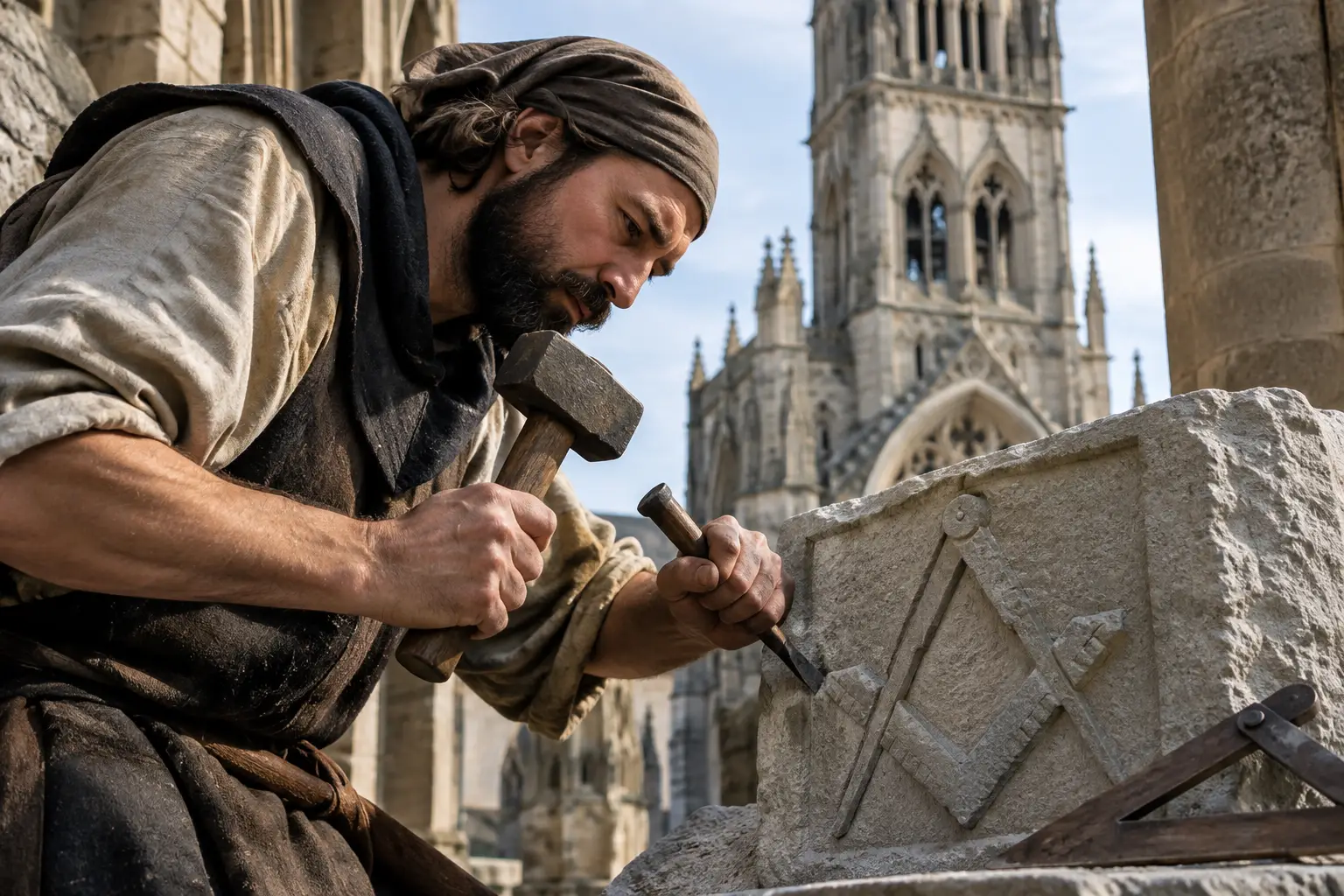
A medieval cathedral was not built by one anonymous workforce. It depended on highly skilled craftspeople who traveled where major projects required them, shared technical knowledge, and worked within a disciplined community. Medieval stonemasons and Freemasonry history are connected through that world of practical skill, fellowship, and moral expectation – but the connection deserves a careful explanation rather than a simple legend.
Modern Freemasonry did not merely preserve a building trade in ceremonial form. Over time, it developed into a voluntary fraternity that used the working tools, stories, and ideals of the mason’s craft to encourage integrity, friendship, respect, and service. Understanding that change helps separate the documented history from the assumptions that often surround Freemasonry.
Medieval Stonemasons and Freemasonry History: The Craft
In the Middle Ages, a stonemason was a trained professional. Building churches, castles, bridges, and civic structures required an understanding of geometry, load-bearing walls, carving, quarrying, and proportion. The work could be dangerous, physically demanding, and highly specialized.
Masons commonly worked in lodges established near a large building project. In this original sense, a lodge was often a practical workplace or shelter where tools could be stored, plans discussed, and work organized. A master mason supervised the project, while apprentices and more experienced workers learned their trade through observation, instruction, and long practice.
The craft had good reasons to protect its knowledge. Skill determined both safety and livelihood. Methods of measuring, shaping stone, and setting out a building could not simply be picked up in an afternoon. Signs, words, and customs may have helped workers identify one another, demonstrate experience, and maintain order within the trade.
This does not mean every medieval building site operated in exactly the same way. Customs differed across regions and centuries, and surviving records are incomplete. Yet the broad picture is clear: stonemasonry fostered communities of skilled people whose work required trust, discipline, and shared standards.
More Than Stone and Tools
The medieval mason’s tools carried practical meaning first. A square tested a right angle. A level helped ensure even work. A plumb rule established vertical accuracy. For a craftsperson, these were necessities of the job.
Later Freemasonry gave such tools an additional moral meaning. The square became associated with fairness and upright conduct; the level with equality; and the plumb with living honestly and responsibly. This use of craft imagery is central to Masonic teaching. It turns familiar objects into reminders that character, like masonry, is built carefully over time.
That symbolic development is not a claim that modern members are medieval builders. It is a deliberate way of preserving the dignity of honest work while applying its lessons to everyday life.
From Operative to Speculative Masonry
Historians often describe the transition as a movement from operative to speculative Masonry. Operative masons worked directly in the building trade. Speculative Masons used the language and symbols of the craft as a framework for ethical reflection, fellowship, and self-improvement.
The transition was gradual, not a single event. By the late sixteenth and seventeenth centuries, records in Scotland show organized lodges connected to the trade and governed by written rules. The Schaw Statutes of 1598 and 1599, for example, set out regulations for Scottish masons and lodges. They provide valuable evidence of a structured craft community.
During the seventeenth century, some men who were not working stonemasons began to be admitted to lodges. These are sometimes called “accepted” or “gentleman” Masons. Their presence suggests that lodge membership was becoming valued for more than professional training alone.
One frequently cited English record concerns Elias Ashmole, who noted in his diary that he was made a Freemason in 1646. Ashmole was not a working stonemason. His experience does not explain every stage of Freemasonry’s development, but it is clear evidence that non-operative membership existed well before the formation of the first Grand Lodge in London.
What the Evidence Can and Cannot Prove
Freemasonry’s history includes traditions that connect the fraternity to ancient builders, biblical figures, and the great projects of the past. These stories have an important place in Masonic symbolism and ritual. They communicate lessons about wisdom, fidelity, labor, and the pursuit of truth.
Historical research asks a different question: what can surviving documents establish? The strongest documentary evidence traces the development of modern Freemasonry through the traditions of stonemasons’ lodges, particularly in Scotland and England, and through the growth of non-operative membership in the seventeenth century.
It is less accurate to state that modern Freemasonry existed unchanged in the medieval period, or that every Masonic custom can be directly traced to a single medieval source. Institutions evolve. Their symbols gather layers of meaning, their practices adapt, and their members respond to the needs of their own time.
That distinction does not weaken the heritage. It makes it more compelling. Freemasonry honors the medieval craft not by pretending history stood still, but by acknowledging how a working tradition became a lasting moral and social institution.
The Formation of Modern Freemasonry
In 1717, four London lodges came together to form what became known as the Premier Grand Lodge of England. This moment is conventionally regarded as the beginning of organized modern Freemasonry, though lodges and Masonic practices were already in existence.
The publication of The Constitutions of the Free-Masons in 1723 gave the developing fraternity a public framework. Compiled by James Anderson, the Constitutions set out a history, rules, and principles for lodge life. They helped establish a model of Freemasonry organized through lodges, governed by Grand Lodges, and united by shared values.
Freemasonry expanded rapidly in Britain and beyond. Its appeal rested partly on ceremony and tradition, but also on the opportunity to meet men from different occupations and backgrounds on equal terms. In the lodge, members could practice civility, fulfill responsibilities, support charitable causes, and form friendships that extended beyond professional or social rank.
The organization has continued to develop while retaining its recognizable framework of lodges, officers, degrees, ceremonial meetings, charitable activity, and mutual support. It remains one of the oldest secular social and charitable organizations in the world.
Why the Stonemason Connection Still Matters
For someone considering Freemasonry, medieval imagery can initially feel distant. Few members now spend their days shaping stone, and a modern lodge is not a medieval construction site. The connection matters because the craft offers a practical language for personal development.
A building is made secure through sound materials, patient work, and attention to detail. Freemasonry applies a similar idea to life. Integrity is practiced when no one is watching. Friendship grows through reliability and shared time. Respect requires listening to people whose experiences differ from our own. Service asks members to direct time and resources toward the well-being of others.
These are not abstract ideals reserved for ceremonial occasions. They can shape how a person approaches family commitments, work, community volunteering, and difficult decisions. The symbols are memorable because they are grounded in the visible realities of building: measure carefully, work honestly, correct faults, and contribute to something larger than yourself.
There is also a social lesson in the old lodge. Medieval building projects depended on cooperation among people with different responsibilities. Modern Freemasonry likewise brings together men of varied backgrounds who agree to meet with courtesy, learn from one another, and support their communities. Political and religious debate are not part of lodge business, allowing members to focus on common values rather than division.
A Heritage Best Understood Clearly
Freemasonry is sometimes described as secret, when a more accurate word is private. Its ceremonies are reserved for members, as are the personal experiences that give those ceremonies meaning. Its charitable purpose, structure, history, and values can be discussed openly.
The story of medieval stonemasons is part of that open history. It explains why Freemasonry speaks in the language of lodges, apprentices, masters, working tools, and building. It also explains why the fraternity places such value on learning, conduct, mutual assistance, and the patient improvement of oneself.
For researchers, the subject rewards precision. For prospective members, it offers a useful perspective: Freemasonry is not an attempt to recreate the Middle Ages. It is a living community that carries forward lessons from a respected craft tradition.
The next time you see a square, level, or plumb displayed in a Masonic setting, consider the ordinary discipline behind the symbol. A well-built life, like a well-built wall, is rarely the product of a single grand gesture. It is formed through steady work, trustworthy companionship, and a willingness to serve.